Three places. One community.
Where faith became a family inheritance.
For the families of Lina’s Road, the church, schoolhouse, and cemetery tell connected parts of one story. Here, faith was practiced alongside the work of raising children, caring for neighbors, learning, and remembering the dead. John Wesley’s importance lies in those everyday acts as much as in the age of its walls.
A churchyard photograph, a wedding date, the name of a choir member, or a remembered prayer connects descendants to this place even when they live far away. Preserving the church means keeping those connections visible and giving the next generation a place to ask where they come from.
The historical record
A congregation before the present building.
- 1877 · A church lot in the land record
The school lot’s October 23, 1877 deed description, reproduced in the 1976 county lease, identifies an adjoining church lot. That reference predates the congregation’s commonly cited founding. It is a research lead, not proof that the present building stood here then.
- 1879 · The congregation’s recorded beginning
The Maryland Historical Trust’s D-595 survey describes a historic Black Methodist congregation founded in 1879. It places the original chapel across Blackwater Road, without establishing its exact location.
- 1891 & 1901 · Family milestones
Community family history records Julie Spicer Ennalls and Lincoln Little Stafford’s marriage here on February 21, 1891, and Dorothy Ann Ennalls and David Abraham McCready’s marriage on November 3, 1901. These milestones show the church’s place in the formation of families.
- 1901 · The present church
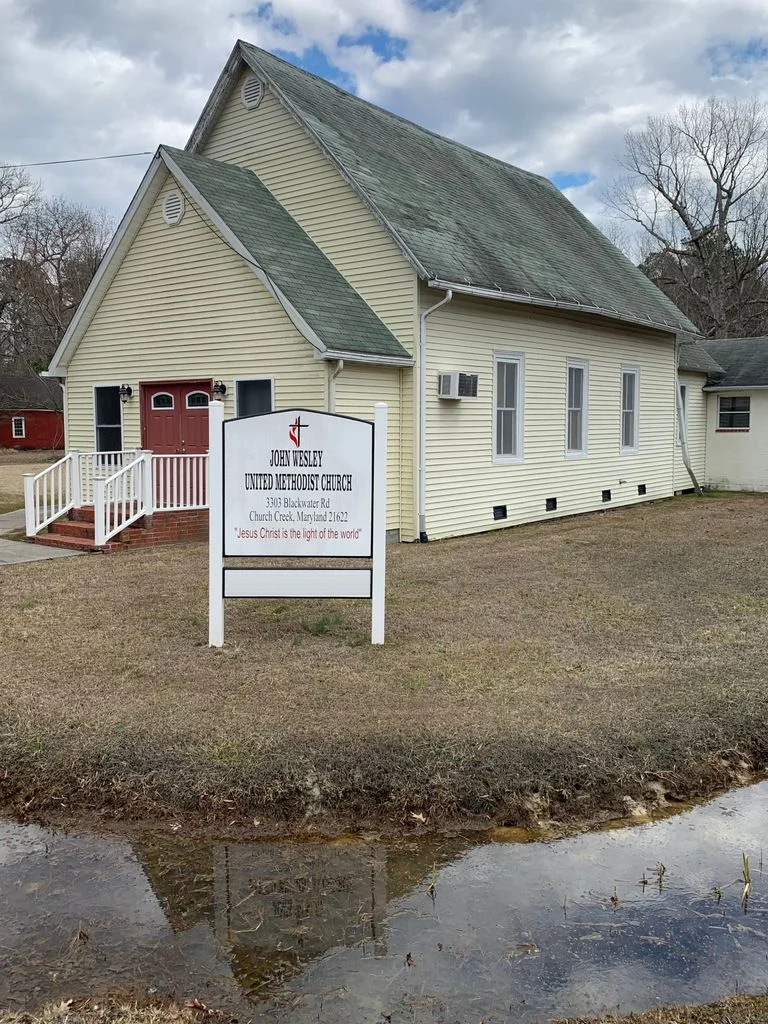
The state survey dates the present building to 1901 and describes a gabled church facing west toward Blackwater Road. The congregation’s founding and this building’s construction are separate milestones.
- 1960 · Family land and congregational care
Thomas T. Spicer’s May 9, 1960 conveyance of approximately four acres opposite the church to its trustees forms part of the cemetery and congregation’s land history. It does not establish the first burial date.
- 1981 · A connected landscape documented
The state survey records the church, neighboring schoolhouse, and cemetery across the road, recognizing religious, educational, and social significance.
The people who kept the doors meaningful.
Worship, weddings, funerals, music, Sunday School, and gatherings made this a place where families met across a lifetime. The photographs of John Wesley’s youth Sunday School preserve that connection between faith and childhood.
Family accounts remember George Harrison Meekins Sr. as a Singing and Praying Band captain, class leader, lay speaker, trustee, choir member, and usher. They remember Mary Catherine Cornish as a communion steward, church clerk, lay speaker, treasurer, and conference delegate. Her April 1985 funeral, and Arthur “Auf” McNamara’s remembrance here in May 2005, are part of that family record.
These names represent work often missing from architectural histories: leading a song, recording a meeting, tending the building, and helping a grieving family. The Group seeks to preserve the church’s sacred character and capacity for worship, memorials, family gatherings, and community history. Please contact the Group about visits and arrangements; this page is not a service schedule.
Our preservation effort
Keep the building. Carry the purpose forward.
The Lina’s Road Community Heritage Group is working toward long-term stewardship of the church, schoolhouse, and cemetery. Its materials describe an October 2025 transfer petition and ongoing title work. A petition or reported approval is not a completed conveyance; the church, cemetery, and county-owned school parcel require distinct documentation.
Protect the structure
Assess roof, exterior, moisture, plumbing, and building systems, then prioritize appropriate repairs.
Care for worship space
Plan sanctuary and pew care, safe access, groundskeeping, utilities, insurance, and maintenance.
Preserve the human record
Collect photographs, programs, names, music, and memories with sources and permission.
These are preservation priorities, not claims that work is funded, contracted, or complete. Condition assessments and documented estimates should guide each phase.
Why we need donations
A church cannot be preserved by memory alone.
Buildings need care between homecomings and reunions. Roof and moisture problems, utilities, insurance, safe access, and ordinary upkeep require resources even when no special event is taking place. Support helps the Group plan practical stewardship while protecting the church’s meaning to the families who sustained it.
You can support church repairs and upkeep, offer skilled help, or share a photograph or memory. The website currently records pledges; it does not process a payment or charge a card.
Sources and questions still open.
The building description and 1879/1901 chronology come from Maryland Historical Trust survey D-595. Land-record context comes from the Group’s September 9, 2026 research compilation and the instruments it identifies. Personal milestones and service roles are retained from the community’s family-history account.
Research continues on the original chapel’s location, the 1877 church-lot reference, and the relationship between congregational and property dates. Preservation plans and title status should be updated from confirmed, dated records. Help add a source or memory.